The rest is channel. Go look at the dull patch on your current pan. That's a coating on top taking every scrape you've given it.
A reliable choice for everyday cooking.


Couldn't load pickup availability

The pan arrived very quickly. I tried it in the oven and absolutely loved it. Nothing but positive things to say. — Sarah
I bought this pan a month ago. My husband tried to talk me out of it, but since I often prepare healthy vegetarian meals just for myself, it has become a real treasure. I cook almost everything without oil, and I don’t even need to wash it—I simply wipe it clean with a damp cloth. The surface heats up quickly. Overall, nothing but benefits! — Emily
This pan is incredibly easy to use. I simply heat it over medium heat and cook anything I want! Meat, fish, and vegetables never stick. Even better, I can finish cooking in the oven. — Megan


They cooked on it. Then they stopped replacing frying pans.


Take it as hot as your burner goes for a sear. Real crust. The core puts the heat back before the food starts steaming in its own juices. Start lower for eggs — the pan can take the top of the dial, your food usually can't.

Your last pan worked when it was new. They all do. Then the middle goes dull and the egg tears and you start using more oil and telling yourself it's fine. This surface is the titanium itself. There is no year three.

Steel whisk. Metal spatula. Dishwasher. Do those things. Don't cut on it, don't heat it empty. Everything else is ordinary cooking.

You've owned that pan. The one that looked perfect on one side and ruined on the other. Every coated pan ends there. The only question is how many times you buy the next one before you notice the pattern.

Your old medium setting is now high. Drop it. Run the water test — if the drop vanishes on contact, the pan is too hot. Ignore that and things will stick and you'll blame the pan. The pan is fine. The dial is wrong.
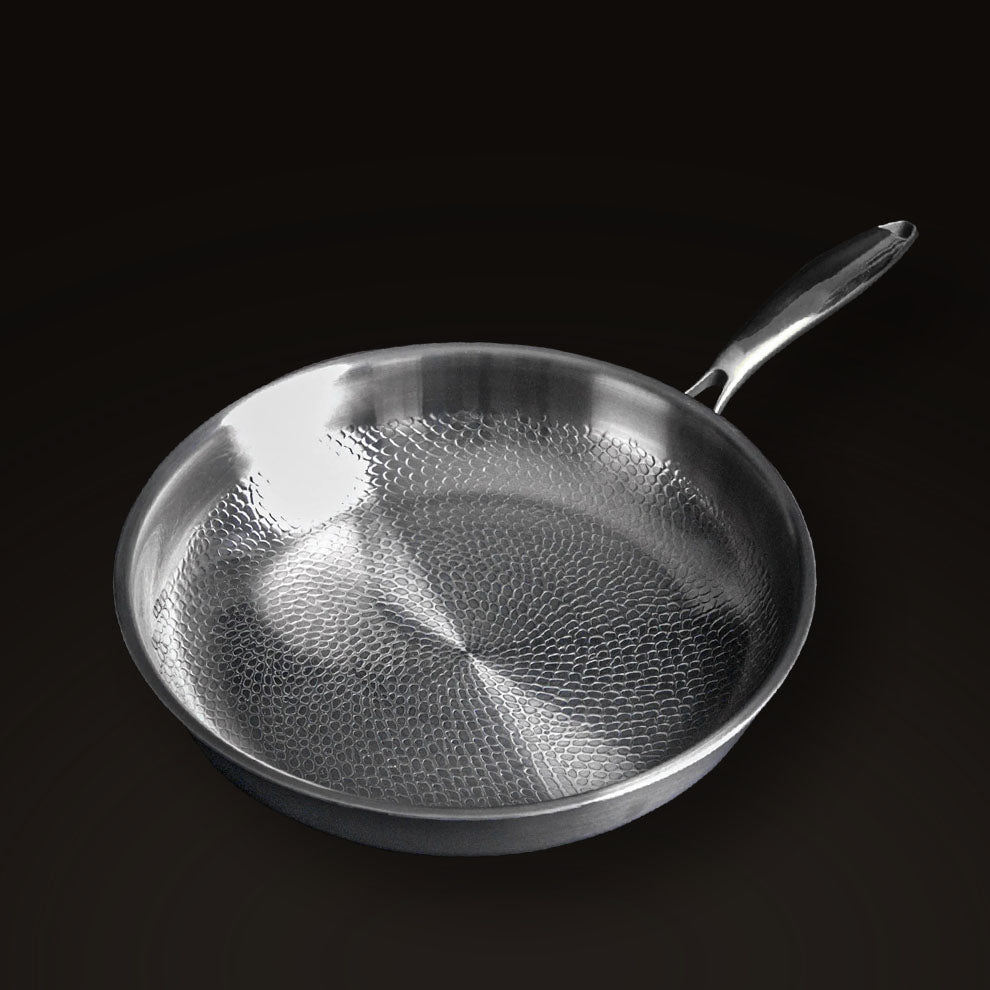
Fat and moisture run into the channels between the ridges. Food sitting in a puddle turns gray. Food sitting above the puddle browns. One design choice. Different dinner.
The egg comes off in one piece. The pan has a weight that feels like a tool. You stop thinking about cookware. You just cook.

| Feature | HULCAN | PTFE non-stick | Ceramic non-stick | Hybrid coated | Stainless | Cast iron |
|---|---|---|---|---|---|---|
| Non-stick comes from | The shape | A coating on top | A coating on top | A coating in the recesses | Nothing | Seasoning |
| Layer that can wear off | None | Yes | Yes | Yes | None | Seasoning |
| Contact ratio | 27% | 99% | 99% | High | 99% | 99% |
| Metal utensils | Yes | No | No | Yes | Yes | Yes |
| Dishwasher | Yes | Usually no | Usually no | Varies | Yes | No |
| Heat rating | 1112 °F | Often limited | Often limited | Varies | High | High |
| Induction | Yes | Some | Some | Usually | Varies | Yes |
| Release when brand new | Strong | Excellent | Excellent | Excellent | Technique | Seasoning |
| Heat retention | Moderate | Low | Low | Moderate | Varies | Excellent |
| Typical replacement cycle | None | 1–3 years | 1–3 years | 2–5 years | Rare | Rare |

Every non-stick pan you've owned started flat and had something sprayed or bonded on top. That layer is what failed in the middle while the edges still looked fine. One metal spatula, one hard sear, one trip through the dishwasher, and six months later you're shopping again.
This pan is solid titanium, raised into a grid. The non-stick is what that shape does. Nothing is applied, so there is nothing to wear through. You can't scratch away a shape.
Solid titanium where the food goes, raised into the Liftgrid pattern that does the releasing. A magnetic base so it works on the induction cooktop you actually have. Rated to 1112 °F / 600 °C — hotter than any oven, broiler or open flame you will ever put it on.
A conventional pan asks one surface to do two opposite jobs: release food and survive metal. It always loses. This one never took the job.
When the chicken sits in its own fat it turns gray. The channels between the ridges pull the liquid away and the food stays in contact with dry hot metal. That's the difference between gray chicken and brown chicken. You can see it happen.


We only email when a new diameter or a restock is actually available, or when the sale price is about to end. A few times a year. That's the list.


 © Hulcan 2026